"Is web scraping legal?"
It is the question every data professional asks before starting a new project.The answer, as with most legal questions, is: it depends.
Web scraping occupies a legal gray area that varies dramatically by country, data type, and how you conduct the scraping.What is perfectly acceptable in one jurisdiction may expose you to significant liability in another.A project that scrapes public product prices might be entirely legal, while scraping personal data from the same website could violate multiple regulations.
This guide provides a comprehensive overview of web scraping laws by jurisdiction in 2025, helping you understand the legal landscape before you extract your first dataset.
The Core Legal Question: When Does Scraping Become Illegal ?
Before diving into specific countries, it helps to understand the common legal frameworks that apply to web scraping worldwide:
** 1. Computer Access Laws **: Many countries have laws criminalizing "unauthorized access" to computer systems.The key question is whether accessing publicly available data constitutes unauthorized access.
** 2. Data Protection and Privacy Laws **: Regulations like GDPR govern how personal data can be collected and processed, regardless of whether it is publicly visible.
** 3. Copyright and Database Rights **: Even if you can legally access data, you may not be able to copy or republish it without permission.
** 4. Terms of Service(ToS) **: Violating a website's ToS may not be criminal, but it can lead to civil lawsuits and breach of contract claims.
** 5. Trespass to Chattels **: An older legal concept applied in some US cases, where excessive server load from scraping is treated as interference with property.
Understanding these frameworks helps you navigate the country-specific regulations below.
United States: The CFAA and "Authorized Access"
The United States has no single federal law that explicitly addresses web scraping.Instead, scraping legality is determined primarily by the ** Computer Fraud and Abuse Act(CFAA) **, copyright law, and an evolving body of case law.
The CFAA Framework
The CFAA prohibits accessing a computer "without authorization" or "exceeding authorized access." For years, courts struggled to define what "without authorization" meant for publicly accessible websites.
This changed with two landmark cases:
** Van Buren v.United States(2021) **: The Supreme Court significantly narrowed the CFAA's scope. The Court held that "exceeds authorized access" applies only when someone accesses information they were not entitled to obtain at all, not when they access data for an improper purpose. This ruling suggested that accessing publicly available data, even in ways a website dislikes, may not violate the CFAA.
** hiQ Labs v.LinkedIn **: This case directly addressed web scraping.hiQ, a data analytics company, scraped publicly available LinkedIn profiles for workforce analytics.LinkedIn sent cease-and-desist letters and blocked hiQ's access.
The Ninth Circuit Court of Appeals ruled that scraping publicly accessible data likely does not violate the CFAA because there is no "gate" or "barrier" to bypass.The court emphasized that when data is freely available to the public, accessing it does not constitute "unauthorized access."
However, the case had a complex ending.In late 2022, a district court found hiQ had breached LinkedIn's User Agreement, and the parties ultimately settled. LinkedIn was awarded $500,000 in damages, and hiQ agreed to delete all scraped data.
What This Means in Practice
In the US, scraping publicly available data without bypassing access controls is generally not a CFAA violation.However, you may still face liability for:
- ** Breach of contract ** if you violate Terms of Service -** Copyright infringement ** if you republish protected content -** State privacy laws ** like the California Consumer Privacy Act(CCPA) if processing personal data of California residents
Recent Developments(2024)
In a July 2024 ruling, a federal jury found an online travel booking company liable under the CFAA for scraping a European airline's website. The key factors: the company used credentials to access data behind a login wall, and the scraping caused actual damage to the airline's systems.
** The takeaway **: Accessing truly public data without bypassing technological barriers remains relatively safe.Data behind login walls, CAPTCHAs, or other access controls is riskier territory.
European Union: GDPR Dominates
The General Data Protection Regulation(GDPR) fundamentally shapes web scraping practices in the EU.Unlike the US approach, which focuses on "unauthorized access," GDPR focuses on the nature of the data being collected.
GDPR and Personal Data
Under GDPR, "personal data" is any information that can identify an individual, directly or in combination with other data.This includes:
-
Names and email addresses -Photos containing faces -IP addresses -Location data -Unique identifiers
** Critical point **: The fact that personal data is publicly visible does not exempt it from GDPR protection.You cannot scrape personal data from public profiles simply because they are public.
Lawful Basis Requirements
To process personal data under GDPR, you need a "lawful basis." The six lawful bases are:
- ** Consent **: The data subject agreed to the processing
- ** Contract **: Processing is necessary for a contract with the data subject
- ** Legal obligation **: Required by law
- ** Vital interests **: To protect someone's life
- ** Public task **: Necessary for official functions
- ** Legitimate interests **: Your legitimate interests outweigh the rights of data subjects
For web scraping, "consent" is almost never practical at scale.Most scrapers rely on "legitimate interests," but this requires a careful balancing test.
The Dutch DPA's Restrictive Stance
In May 2024, the Dutch Data Protection Authority issued guidance stating that commercial "legitimate interests" are unlikely to justify personal data scraping by private companies.The Dutch DPA considers large-scale web scraping "almost always unlawful" and suggests only highly targeted, limited scraping might be permissible.
This represents one of the strictest interpretations of GDPR's application to scraping. Other EU member states may have slightly different approaches, but the overall direction is toward restriction.
GDPR Compliance Checklist for Scrapers
If you must scrape personal data of EU residents, consider:
-[] Conduct a Data Protection Impact Assessment(DPIA) -[] Document your lawful basis(most likely legitimate interest) -[] Minimize data collection to what is strictly necessary -[] Define data retention limits -[] Prepare to handle data subject access requests -[] Respect robots.txt and technical barriers -[] Implement appropriate security measures
Penalties
GDPR violations can result in fines up to €20 million or 4 % of global annual revenue, whichever is higher.By the end of 2024, cumulative GDPR fines had exceeded €5.8 billion, with €1.2 billion issued in 2024 alone.
United Kingdom: Post-Brexit Continuity
After Brexit, the UK retained GDPR principles through the ** Data Protection Act 2018 ** and the ** UK GDPR **.The legal framework remains largely aligned with the EU.
Key UK Legislation
** Computer Misuse Act 1990 **: Criminalizes unauthorized access to computer systems.Bypassing security measures or accessing restricted areas can trigger criminal liability.
** Data Protection Act 2018 / UK GDPR **: Mirrors EU GDPR requirements.Personal data scraping requires a lawful basis, and the same principles of data minimization and purpose limitation apply.
** Copyright, Designs and Patents Act 1988 **: Protects databases and original content.Extracting a "substantial part" of a protected database without permission is illegal.
Practical Considerations
The UK's Information Commissioner's Office(ICO) has been increasingly active in scrutinizing data scraping practices, particularly concerning personal information used for AI training.
If scraping UK users' personal data:
-Ensure you have a lawful basis -Comply with data subject rights -Avoid accessing data behind authentication -Document your compliance measures
Canada: PIPEDA and Copyright Concerns
Canada's web scraping legal framework combines privacy law, copyright law, and evolving jurisprudence.
PIPEDA and Personal Information
The ** Personal Information Protection and Electronic Documents Act(PIPEDA) ** governs collection and use of personal information in commercial activities.Under PIPEDA:
- Personal information, even if publicly accessible, remains protected -Collection typically requires consent or a lawful basis -Organizations must be transparent about their data collection practices
In October 2024, the Office of the Privacy Commissioner of Canada joined international privacy authorities in issuing a joint statement emphasizing that platforms must protect personal information from unlawful scraping.This signaled increased regulatory attention to mass data collection practices.
Canadian Copyright Act
The ** Canadian Copyright Act ** protects original works.Key considerations:
- Scraping copyrighted content(articles, images, creative works) without permission can lead to infringement claims -News aggregation and AI training using scraped content face increasing legal scrutiny
- Technological protection measures(TPMs) that prevent copying are legally protected
Court Trends
Canadian courts have indicated that scraping is generally not permissible when it involves:
- Bypassing technological protective measures -Unauthorized copying and distribution of third-party content -Systematic harvesting of personal data without consent
Future rulings in 2024 and 2025 are expected to further clarify these boundaries, particularly regarding AI uses of scraped data.
Japan: Research-Friendly, Business-Cautious
Japan's legal framework is relatively permissive for research and non-commercial uses but becomes more restrictive for business applications.
Key Legislation
** Personal Information Protection Law(PIPL) **: Governs collection and use of personal data.Amendments taking effect in 2025 strengthen oversight of cross-border data transfers and clarify obligations for AI systems handling personal data.
** Unfair Competition Prevention Act **: Can apply if scraping constitutes unfair competition or involves unauthorized access methods.
** Copyright Law **: Protects original content, but analytical uses may be exempt under certain conditions.
Practical Guidelines
Japan tends to be more permissive for:
-Academic research and non-commercial analysis -AI training using publicly available data (with some limitations)
- Scraping non-personal, factual information
Japan is more restrictive for:
-Commercial scraping of personal data without clear purpose -Accessing data behind authentication -Republishing copyrighted content
Violating website terms of use that explicitly prohibit scraping can lead to civil liability for breach of contract.
Australia: Uncertain Terrain
Australia lacks specific web scraping legislation, creating uncertainty for practitioners.
Relevant Laws
** Privacy Act 1988 **: Applies when collecting personal information.The Australian Privacy Principles(APPs) require consent or a lawful basis for collection.
** Copyright Act 1968 **: Protects original works and databases.Commercial scraping rarely qualifies for "fair dealing" exceptions.
** Criminal Code **: Aggressive scraping that bypasses security or accesses restricted areas can potentially be prosecuted as "computer trespass."
Key Considerations
-Scraping publicly available, non-personal data is generally lower risk -Collecting personally identifiable information without consent raises significant legal issues -Breaching website terms of service can lead to contractual disputes -The legal landscape remains "uncertain" with limited judicial precedent
Comparative Summary: Web Scraping Laws by Country
| Country | Public Non-Personal Data | Personal Data | Data Behind Logins | ToS Violations |
|---|---|---|---|---|
| ** United States ** | Generally permitted | State laws apply(CCPA) | CFAA risk | Civil liability |
| ** EU(GDPR) ** | Generally permitted | Requires lawful basis(strict) | High risk | Civil liability |
| ** United Kingdom ** | Generally permitted | UK GDPR applies | Criminal risk | Civil liability |
| ** Canada ** | Generally permitted | PIPEDA applies | High risk | Civil liability |
| ** Japan ** | Permitted | PIPL applies | Civil risk | Civil liability |
| ** Australia ** | Uncertain | APP applies | Potential criminal risk | Civil liability |
Best Practices for Legal Web Scraping
Regardless of jurisdiction, following these guidelines reduces legal risk:
1. Scrape Public, Non-Personal Data When Possible
The safest scraping involves factual, non-personal information from public pages: product prices, business addresses, published statistics.Avoid personal data unless you have a clear lawful basis.
2. Respect Robots.txt(With Caveats)
While robots.txt is not legally binding in most jurisdictions, respecting it demonstrates good faith.However, some courts have noted that robots.txt alone does not determine legal access.
3. Avoid Bypassing Technical Barriers
Do not circumvent CAPTCHAs, login walls, or rate limits.Accessing data behind these barriers significantly increases legal risk.
4. Read Terms of Service
While ToS violations are typically civil(not criminal) matters, they can still result in lawsuits, cease-and-desist letters, and damages claims.
5. Implement Rate Limiting
Aggressive scraping that overloads servers can trigger "trespass to chattels" claims and may be considered unauthorized access.Use reasonable delays between requests.
6. Document Your Compliance
Keep records of your lawful basis analysis, what data you collect, and why.If challenged, documentation demonstrates you acted in good faith.
7. Stay Current
Web scraping law evolves rapidly.What was acceptable in 2023 may not be in 2025. Monitor legal developments in your target jurisdictions.
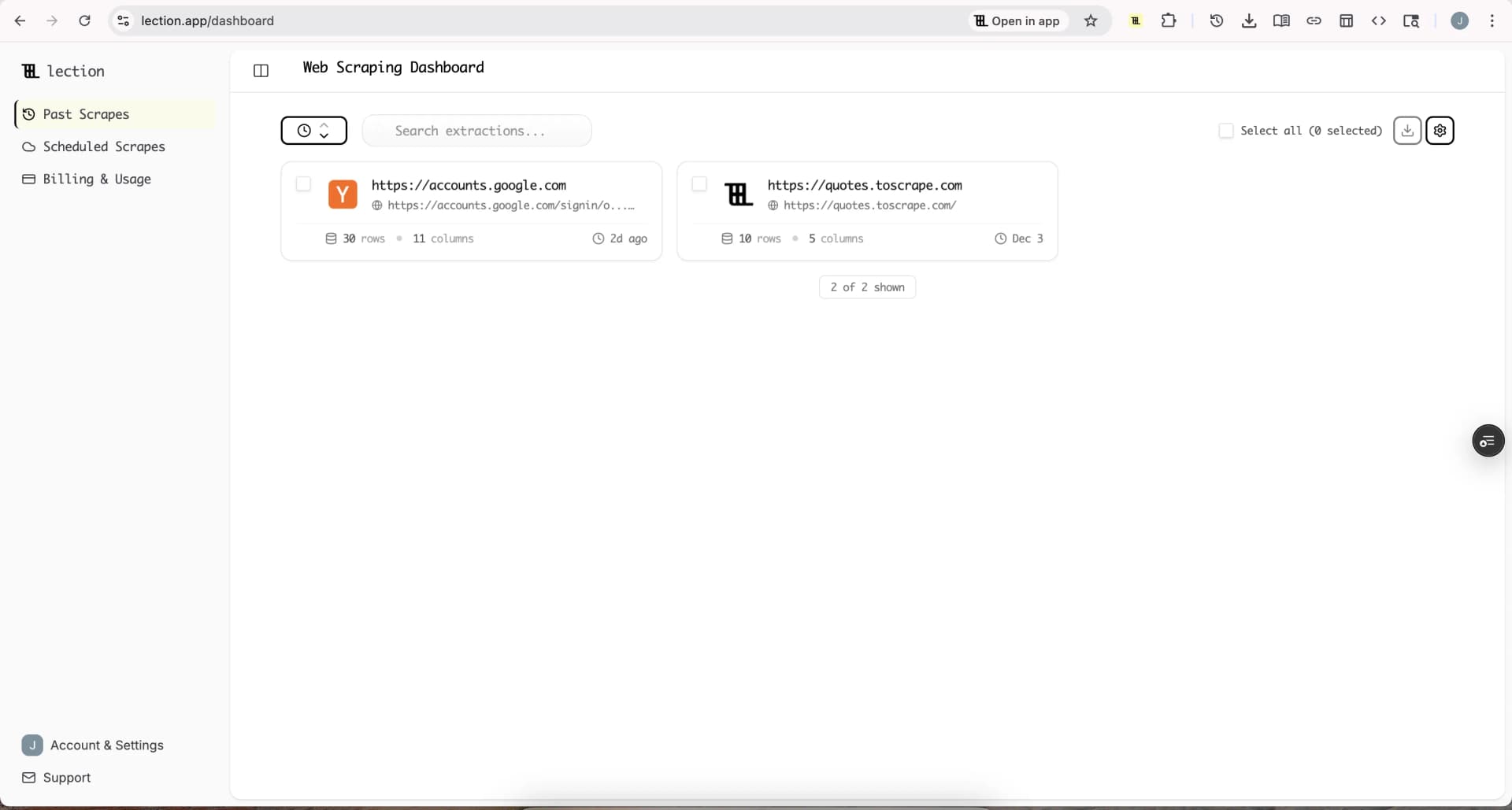
How Tools Like Lection Help with Compliance
Modern scraping tools can help you stay on the right side of legal boundaries.
Lection includes features designed with compliance in mind:
** Browser-Native Operation **: Lection runs in your browser, mimicking normal user behavior rather than aggressive automated attacks on servers.
** Built -in Rate Limiting **: Smart delays between requests reduce server load and avoid triggering anti-bot systems.
** Transparent Data Handling **: Export data directly to Google Sheets, Excel, or other tools you control, giving you full visibility and control over collected data.
** Publicly Accessible Data Focus **: Lection works on pages you can visit normally in your browser, not behind authentication or CAPTCHAs.
When you need to collect web data, using tools that operate transparently and respect website boundaries is not just ethical; it is increasingly required for legal compliance.
Common Pitfalls to Avoid
Assuming Public Means Free to Use
Just because data is publicly visible does not mean you can collect and use it freely.Personal data, copyrighted content, and database rights persist regardless of whether information is behind a paywall.
Ignoring Terms of Service
Even if ToS violations are not criminal, they can result in expensive lawsuits.LinkedIn's suit against hiQ ultimately resulted in a settlement requiring deletion of all scraped data.
Overlooking Cross-Border Issues
If you scrape data about EU residents from a US-based server, GDPR still applies.Global businesses must consider the regulations of their data subjects' jurisdictions, not just their own location.
Underestimating Enforcement
GDPR enforcement is real and growing. €1.2 billion in fines were issued in 2024 alone.Regulatory bodies are increasingly attentive to scraping-related violations.
Conclusion: Scrape Responsibly
Web scraping occupies a complex legal landscape.The clearest path to legality involves:
- Focusing on publicly accessible, non-personal data -Avoiding authentication bypass and technical barriers -Understanding the regulations of jurisdictions where your data subjects reside -Using tools and practices that demonstrate good faith compliance
The good news: for most business use cases, legal web scraping is entirely achievable.Extracting product prices, monitoring public market data, and collecting business information from company websites generally presents low legal risk when done correctly.
The risks increase when scraping personal data, bypassing access controls, or operating at scales that burden target websites.Understanding these boundaries allows you to collect the data you need while staying compliant.
Ready to start scraping responsibly ? Install Lection and extract your first dataset using a tool built with compliance in mind.
Related Reading
- GDPR Compliance Checklist for Data Scrapers
- Ethical Web Scraping Principles for Businesses
- Complete Guide to robots.txt for Web Scrapers (2025)
- Explore all tutorials and guides
Disclaimer: This article is for informational purposes only and does not constitute legal advice. Consult with a qualified attorney for advice specific to your situation and jurisdiction.