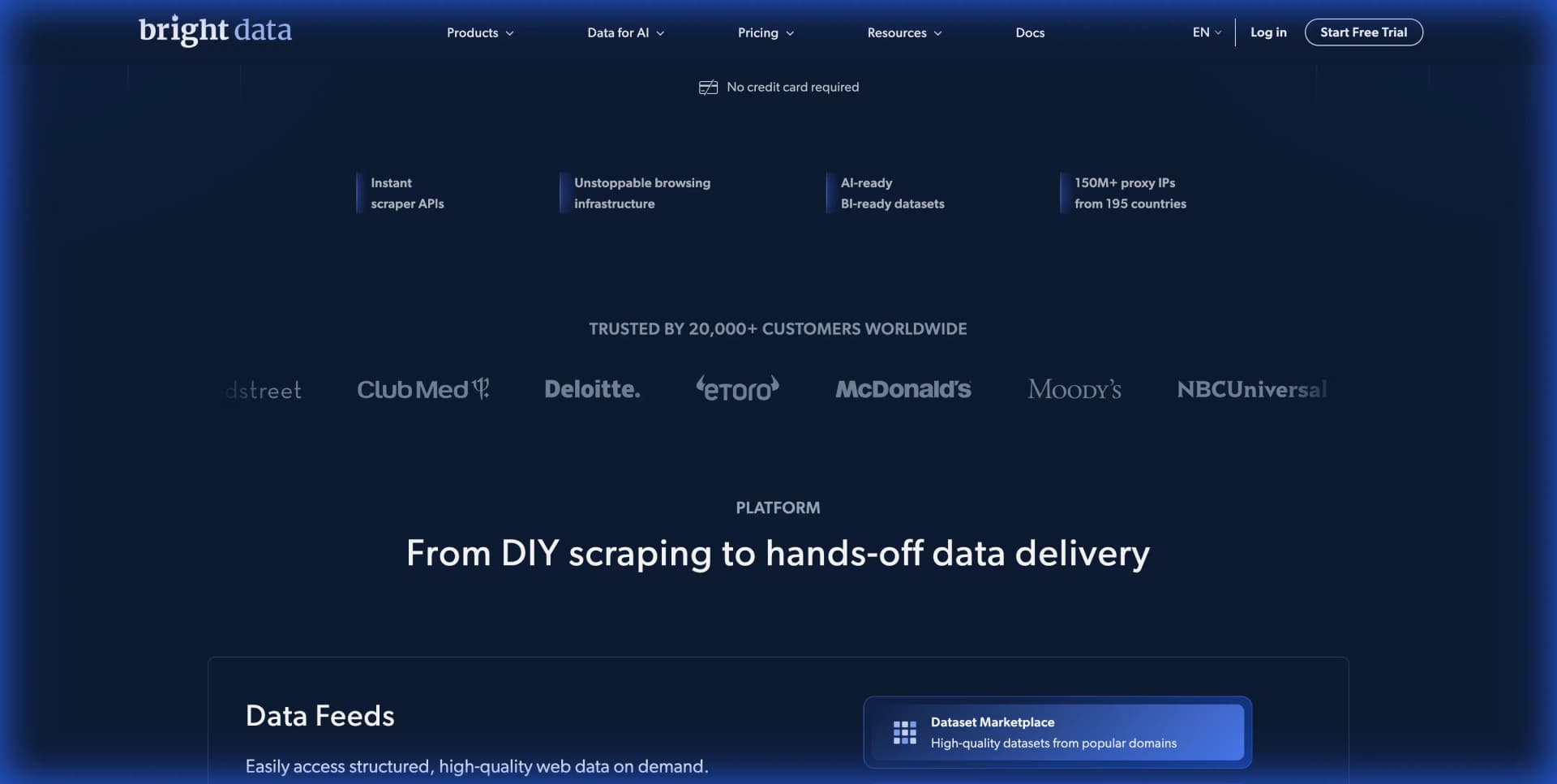
Bright Data is one of the most powerful data collection platforms on the market. With over 150 million proxy IPs spanning 195 countries, enterprise-grade infrastructure, and a suite of tools ranging from scraping browsers to pre-built data collectors, it has earned its reputation as the go-to solution for large-scale web scraping operations.
But here is the uncomfortable truth that most comparison articles will not tell you: Bright Data is not built for everyone.
If you are a solo founder trying to gather competitor pricing data, a marketing manager building lead lists, or a researcher collecting social media posts for analysis, Bright Data's complexity and cost structure can feel like bringing a firehose to water a houseplant.
In this guide, we will walk through the best Bright Data alternatives in 2026, with a special focus on no-code options that let you extract web data without writing scripts, managing proxies, or understanding what "CAPTCHA bypass" even means.
Quick answer: the best Bright Data alternatives in 2026
- Lection: an AI web scraper Chrome extension for non-developers. Describe the columns, then scrape any website to Google Sheets on a schedule.
- Oxylabs: premium proxies and scraper APIs, the closest like-for-like swap for developers.
- Apify: a marketplace of ready-made scrapers (Actors) plus cloud runs.
- ScraperAPI: send a URL, get HTML back, with proxies and rendering handled for you.
- Octoparse: a desktop workflow builder with cloud runs on paid plans.
- Decodo (formerly Smartproxy): lower-cost proxies if you already have your own scraper.
Why Look for a Bright Data Alternative?
Before diving into alternatives, let us understand when Bright Data makes sense and when it does not.
When Bright Data is the Right Choice
Bright Data excels for:
- Enterprise-scale operations extracting millions of pages daily
- Teams with dedicated developers who can maintain scraping infrastructure
- Use cases requiring residential proxies for accessing geo-restricted content
- Organizations with $500+/month budgets for data infrastructure
When You Need an Alternative
You might need a different solution if:
- You do not have a developer on staff. Bright Data's Web Scraper IDE requires JavaScript knowledge. Their documentation assumes familiarity with Puppeteer, Playwright, and API integration.
- Your budget is limited. Its Web Scraper API has a free tier of 5,000 records a month, then pay-as-you-go at $1.50 per 1,000 records; the first monthly plan (Scale) is $499/month. At volume that adds up quickly.
- You just need data, not infrastructure. Managing proxy rotation, handling CAPTCHAs, and debugging failed requests is work. If you simply want to "get the data into a spreadsheet," that infrastructure feels like unnecessary overhead.
- You want something faster. Setting up a Bright Data workflow from scratch takes hours of configuration. Some alternatives let you extract data in minutes.
The Best Bright Data Alternatives in 2026
1. Lection (Best for No-Code Users)
Lection represents a fundamentally different approach to web scraping. Instead of building scraping infrastructure, you install a Chrome extension and describe the data you want.
Why Lection stands out:
- No selectors or workflow builder: describe the columns in the side panel ("product name, price, rating") and check the preview before you run it.
- Multi-page runs: Next links, Load More buttons, infinite scroll and detail pages in one run (guide).
- Browser-based: runs in your own Chrome, so it works on pages you're already logged into.
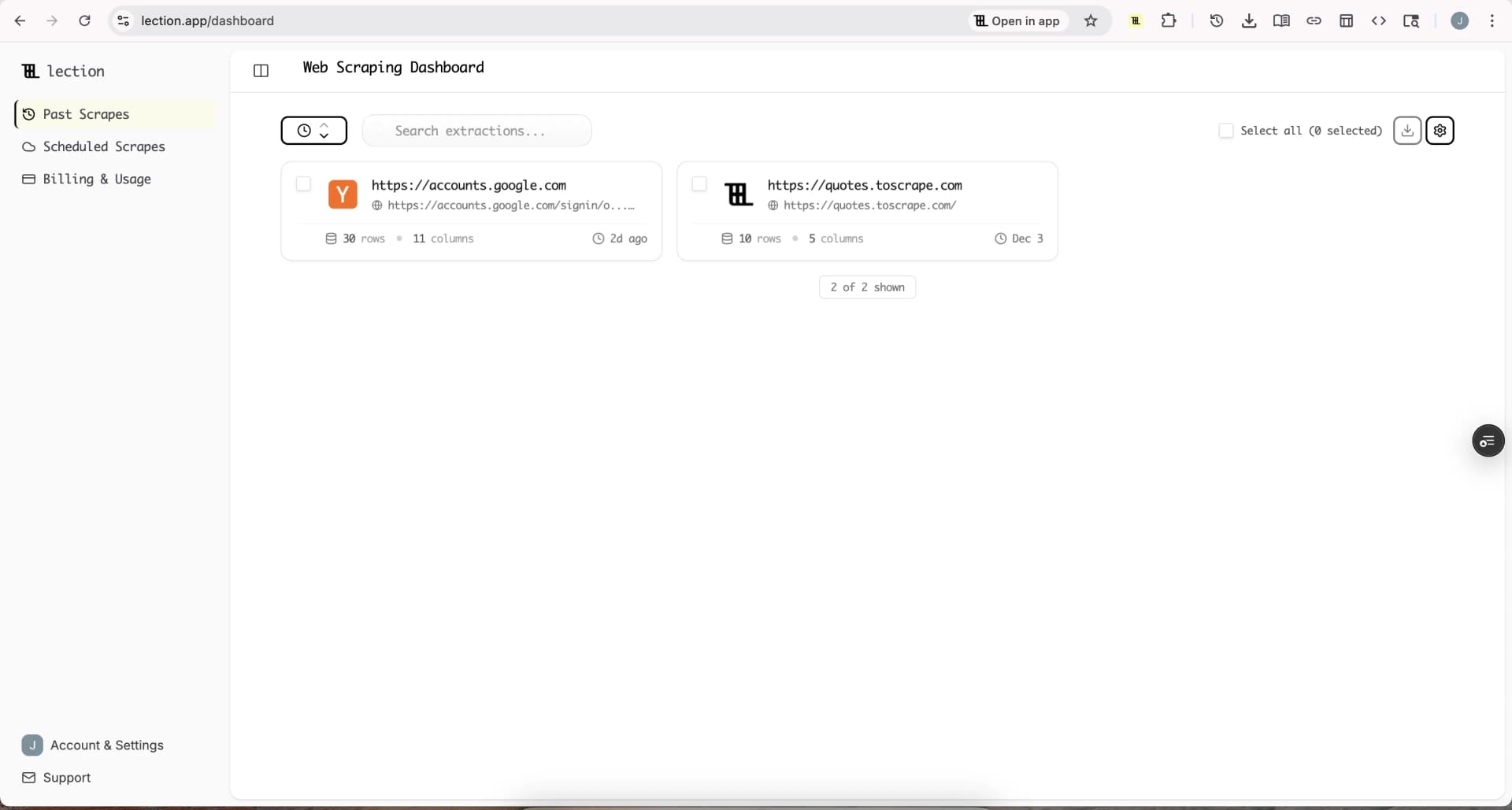
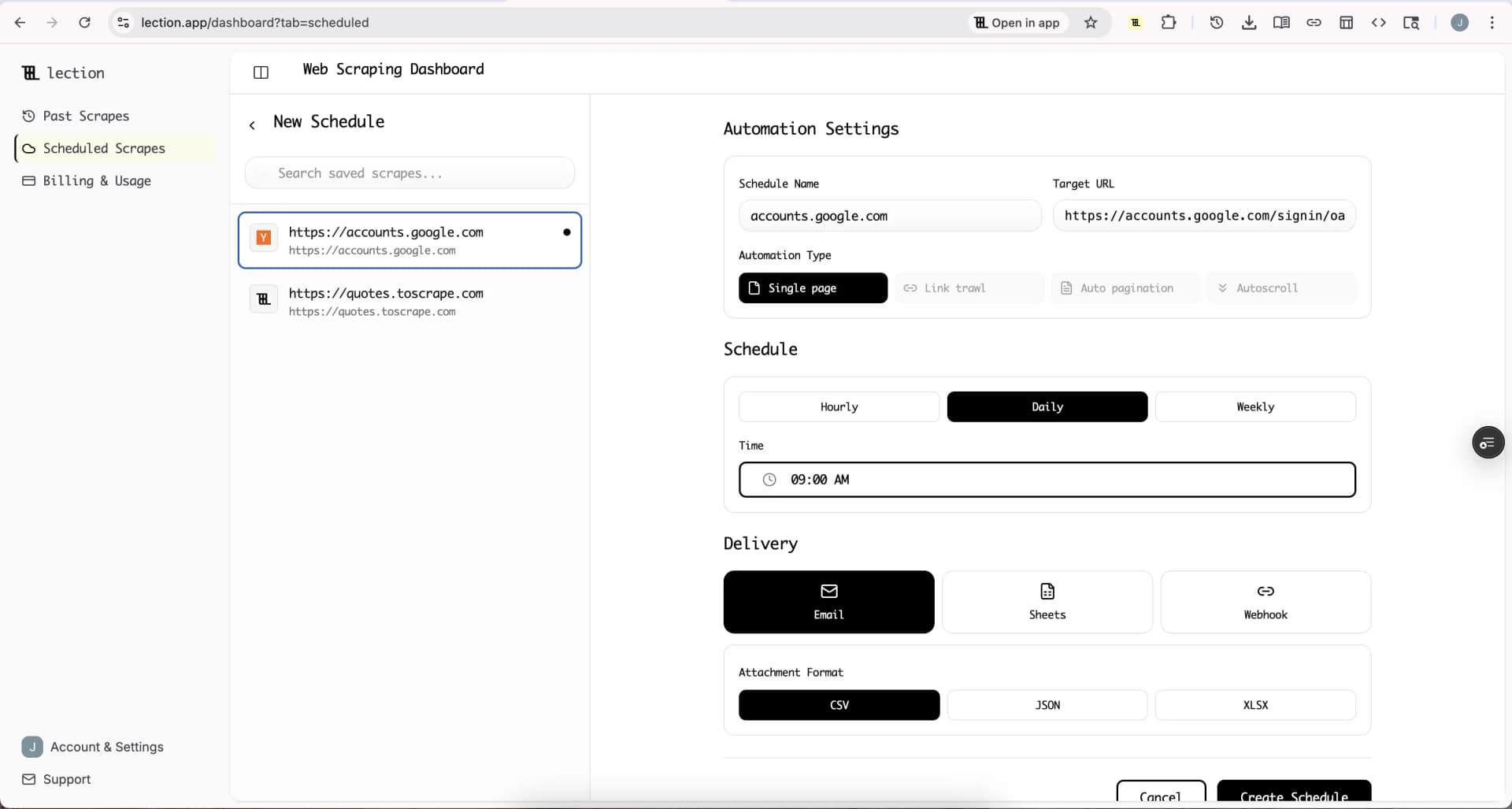
- Schedules: saved scrapes rerun daily on the Free plan; Standard adds hourly runs, Google Sheets, webhooks and change alerts.
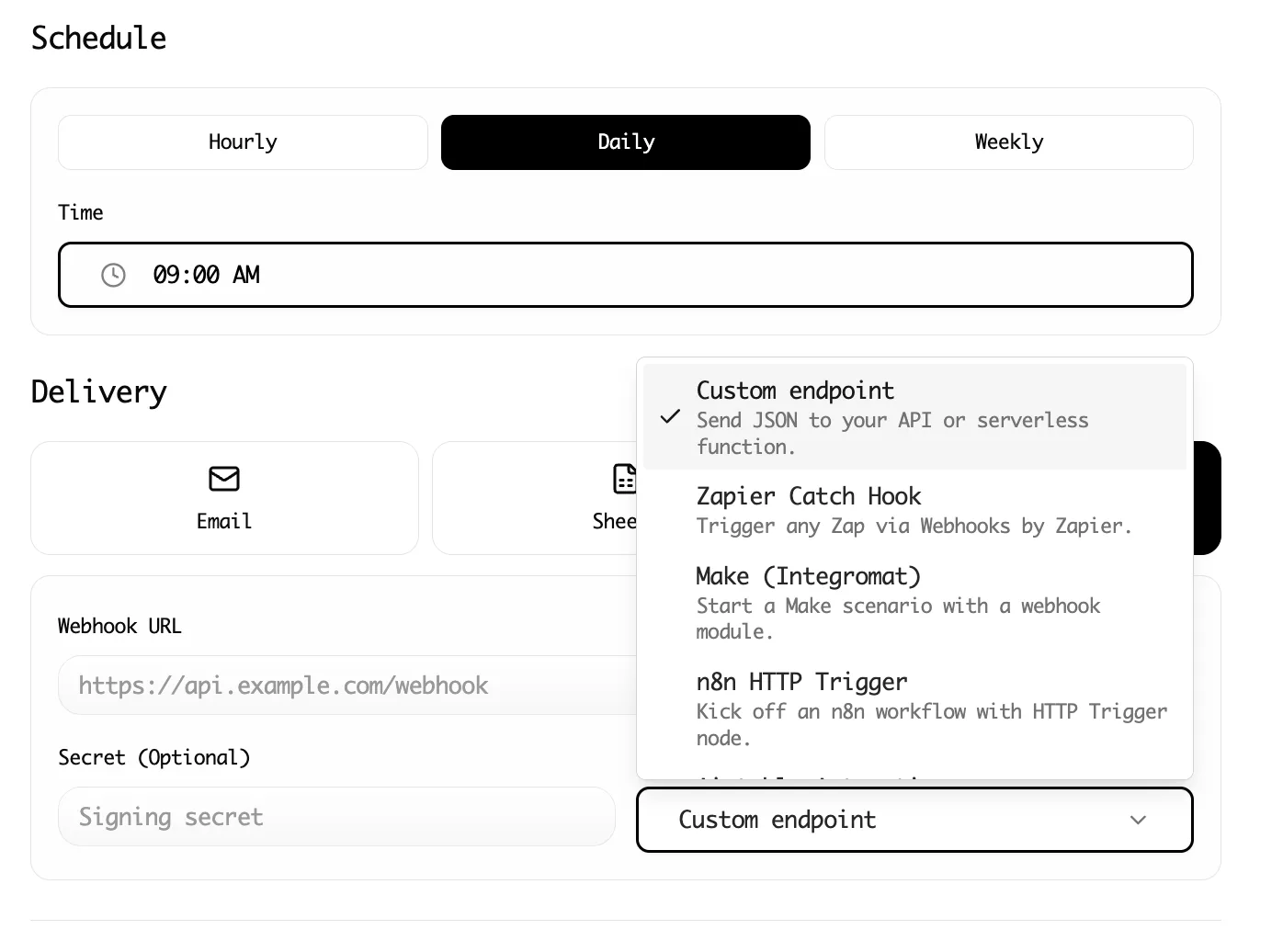
- Integrations: CSV/Excel download, Google Sheets, Zapier and Make.
Best for: Marketing teams, growth hackers, researchers, founders, and anyone who needs web data without a development background.
Pricing: Free plan with 5 credits a month (1 credit = 100 downloaded rows, 1 AI session or 20 cloud pages); Standard $29/month; Pro $99/month; 30-day Standard trial. See pricing.
Ready to try it? Install Lection from the Chrome Web Store and extract your first dataset in under 5 minutes.
2. Oxylabs
Oxylabs is Bright Data's closest competitor in the premium proxy and scraping space.
Key features:
- Over 100 million residential IPs across 195 countries
- Industry-leading 99.95% success rates
- Multiple proxy types: residential, datacenter, ISP, and mobile
- Pre-built scraping APIs for popular sites (Amazon, Google, real estate)
The tradeoff: Oxylabs is designed for developers and enterprises. If you are looking for a "Bright Data alternative without coding," this is not it. You will still need technical expertise to integrate their APIs and manage your scraping logic.
Pricing: Similar to Bright Data starting around $99/month for basic plans, with enterprise pricing for high-volume needs.
Best for: Technical teams who find Bright Data's interface cumbersome but still want premium proxy infrastructure.
3. Apify
Apify takes a different approach by offering a marketplace of pre-built "Actors" (their term for scraping scripts) that handle specific websites.
Key features:
- Thousands of ready-made scrapers for popular sites
- Visual workflow builder for non-developers
- Cloud hosting for automated runs
- Good documentation and community support
The tradeoff: While Apify offers no-code options, the learning curve is steeper than pure browser extensions. Understanding their Actor model and Apify Console takes time.
Pricing: Free plan with a small monthly usage credit; paid plans are usage-based. Check Apify pricing for current tiers.
Best for: Teams who want pre-built solutions for common scraping tasks (LinkedIn, Amazon, Instagram) without building from scratch.
4. ScraperAPI
ScraperAPI simplifies web scraping by handling the infrastructure headaches for you: proxy rotation, CAPTCHA solving, and browser rendering.
Key features:
- Simple API: Send a URL, get the HTML back
- Automatic proxy rotation and retries
- JavaScript rendering for dynamic sites
- Geo-targeting for location-specific data
The tradeoff: ScraperAPI gives you raw HTML. You still need to parse it yourself. If you do not know how to extract data from HTML, you will need additional tools or coding.
Pricing: Free plan with 1,000 API credits (plus a 7-day trial with 5,000). Paid plans start at $49/month. See our ScraperAPI alternatives for how its credit costs vary by site.
Best for: Developers who want to avoid managing proxy infrastructure themselves.
5. Octoparse
Octoparse is a mature visual scraping tool with desktop application and cloud options.
Key features:
- Point-and-click workflow builder
- Pre-built templates for popular sites
- Cloud extraction for automated runs
- Data export to Excel, CSV, and databases
The tradeoff: Octoparse has a steep learning curve. Their desktop software is powerful but complex. When websites change structure, you often need to manually repair broken workflows.
Pricing: Free plan with local runs only; Standard starts at $69/month billed yearly, and cloud runs and scheduling are on paid plans (Octoparse pricing, checked November 2026).
Best for: Users willing to invest time learning a comprehensive tool for ongoing scraping projects.
For a deeper comparison, read our Lection vs Octoparse guide.
6. Decodo (formerly Smartproxy)
Decodo offers a balance of features and affordability in the residential proxy space.
Key features:
- 65M+ residential IPs
- Competitive pricing compared to Bright Data
- Web scraping APIs for common use cases
- Good success rates for protected sites
The tradeoff: Like Bright Data, Decodo is primarily proxy infrastructure. You need technical skills to build scrapers on top of their network.
Pricing: Pay-as-you-go starting at $2.20/GB for residential proxies.
Best for: Developers seeking a more affordable alternative to Bright Data's residential proxies.
Feature Comparison: Bright Data vs. Alternatives
| Tool | No-Code | Cloud Scraping | AI-Powered | Starting Price | Best For |
|---|---|---|---|---|---|
| Lection | ✅ Full | ✅ Yes | ✅ Yes | Free tier | Non-technical users |
| Bright Data | ❌ Limited | ✅ Yes | ❌ No | Free tier, then $1.50/1K records or $499/mo | Enterprise teams |
| Oxylabs | ❌ No | ✅ Yes | ❌ No | ~$99/mo | Developers |
| Apify | ⚠️ Partial | ✅ Yes | ❌ No | Free/$19/mo + usage | Pre-built scripts |
| ScraperAPI | ❌ No | ✅ Yes | ❌ No | Free/$49/mo | API developers |
| Octoparse | ⚠️ Partial | ✅ Paid plans | ❌ No | Free/$83/mo ($69 yearly) | Power users |
| Decodo | ❌ No | ✅ Yes | ❌ No | ~$2.20/GB | Proxy users |
Bright Data, Apify and Octoparse prices checked on November 16, 2026 from each vendor's pricing page.
What to Consider When Choosing a Bright Data Alternative
1. Technical Skill Level
Be honest about your team's capabilities. If you do not have a developer, tools like Oxylabs, ScraperAPI, or Bright Data itself will leave you stuck. Lection and visual tools like Octoparse are designed for non-technical users.
2. Budget Constraints
Bright Data's pricing is complex: per-GB proxy costs, per-1000-request API costs, compute time charges. It is easy to underestimate monthly bills. If predictable pricing matters, look for tools with clear tier structures.
3. Scale Requirements
For millions of pages monthly, enterprise solutions make sense. For 100-10,000 extractions per month, browser-based tools like Lection offer better ROI with zero infrastructure overhead.
4. Data Freshness Needs
If you need real-time monitoring (tracking competitor prices every hour), cloud scraping with scheduling is essential. Lection's cloud scraping lets you schedule recurring extractions.
5. Integration Requirements
Consider where your data needs to go. If your workflow lives in Google Sheets or Airtable, direct integrations save copy-paste headaches. Lection's integrations include Google Sheets, Zapier, Make, and webhooks for custom workflows.
Common Pitfalls When Switching from Bright Data
Underestimating the Learning Curve
Even "no-code" tools have learning curves. Allocate time for your team to experiment. The good news: tools like Lection have dramatically shorter ramp-up times than infrastructure-heavy solutions.
Ignoring Website Changes
Web scraping is inherently fragile because websites change. Traditional scrapers break when a site updates its HTML. AI-powered tools like Lection adapt to changes automatically, reducing maintenance burden.
Overlooking Compliance
Bright Data emphasizes ethical scraping practices and GDPR compliance. When switching to alternatives, ensure your chosen tool respects robots.txt, implements reasonable rate limits, and handles data responsibly.
Conclusion: The Right Tool for the Right Job
Bright Data is a powerful platform, but power comes with complexity. For many teams, the question is not "Can we use Bright Data?" but "Should we?"
If you have the budget, developers, and need for massive scale, Bright Data remains a strong choice. But if you want to:
- Extract web data without coding
- Avoid managing proxy infrastructure
- Get started in minutes instead of hours
- Pay only for what you use
Then a modern, AI-native alternative like Lection may be exactly what you need.
The future of web scraping is not about building more infrastructure. It is about intelligence. Agents that understand web pages, adapt to changes, and deliver clean data where you need it.
Ready to experience the difference? Install Lection for free and see how fast you can go from "I need this data" to "I have this data."