SerpApi is a practical choice when an application needs search engine results in a predictable JSON response. It supports multiple search engines, location parameters, structured result fields, and a familiar API workflow. That makes it useful for rank tracking, competitive research, shopping analysis, and software that needs current search data without maintaining its own search result parser.
The right alternative depends on what happens before and after the request. A developer may want an API with a stable schema and clear throughput limits. An SEO analyst may need a repeatable way to inspect results, collect related pages, and export a dataset without writing code. A larger data team may prefer a pay-as-you-go queue, specialized SERP endpoints, or a vendor that can support a production pipeline.
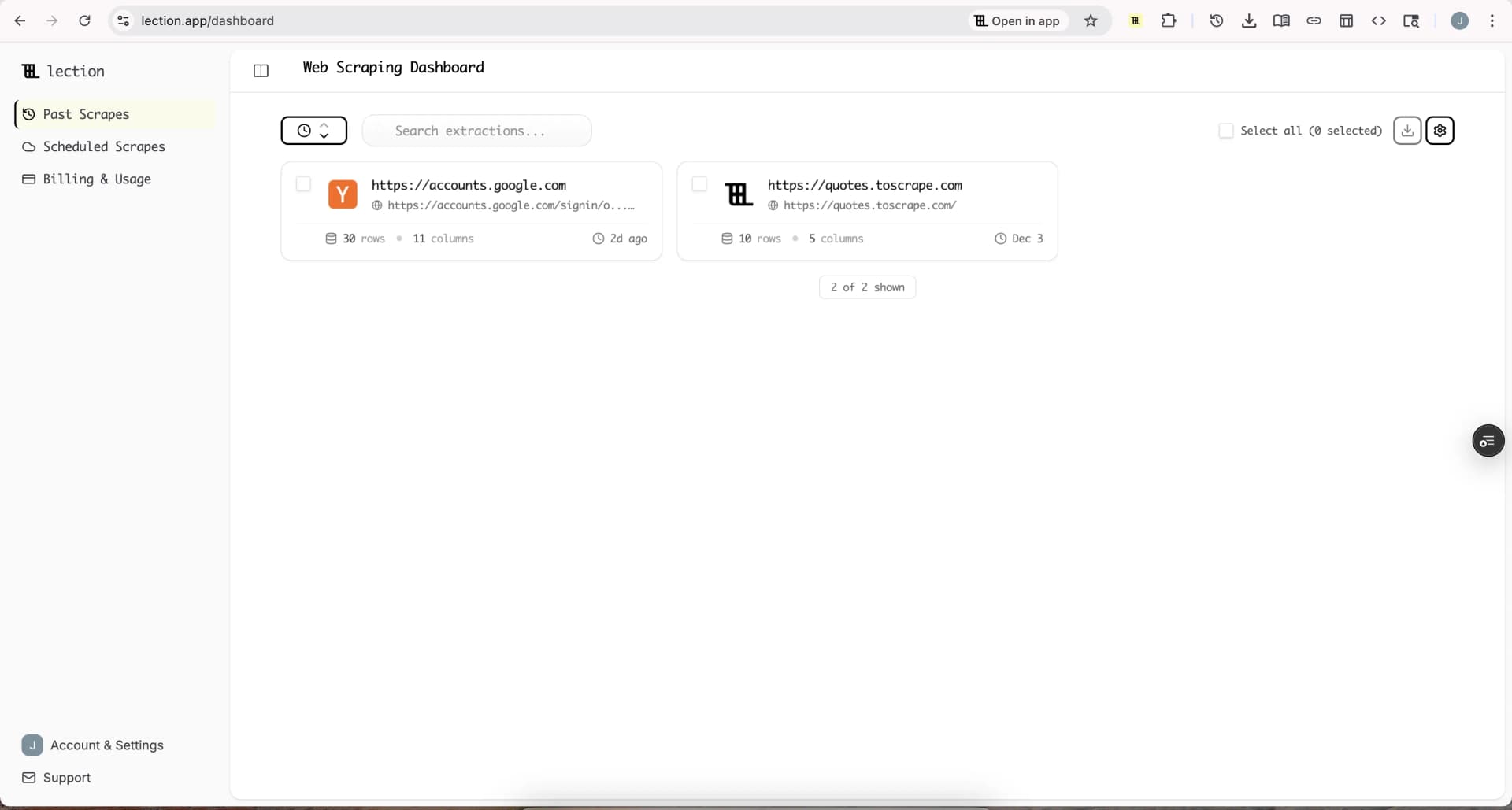
Lection is the AI-native option for fast, accurate scraping right in your browser. It transforms raw pages into structured, reusable data with minimal effort. The difference is important: instead of asking only for a search response, you can define a visible workflow around the result page, including fields, pagination, links, and the next research step.
Why look beyond SerpApi?
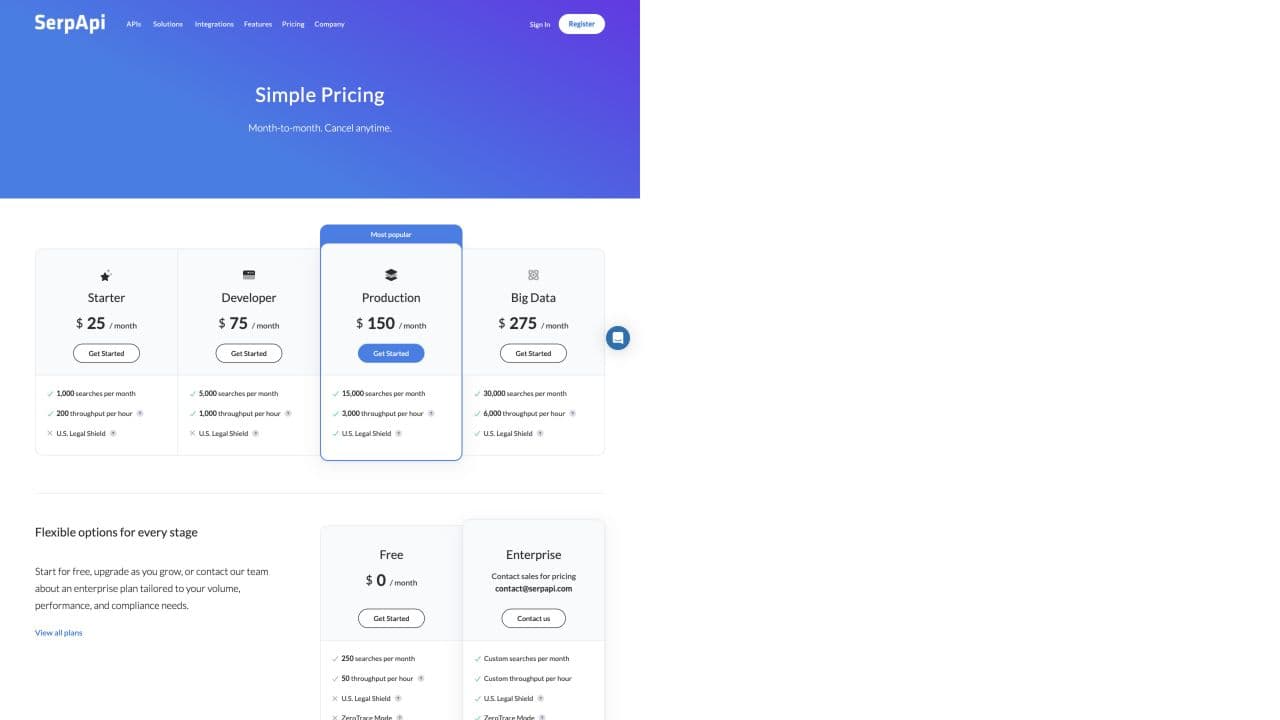
SerpApi's current pricing page lists a free plan with 250 searches per month. Paid plans shown on the page begin with Starter at $25 per month for 1,000 searches, Developer at $75 for 5,000, Production at $150 for 15,000, and Big Data at $275 for 30,000. The page also lists higher-volume plans, throughput limits, U.S. Legal Shield, and additional options such as ZeroTrace Mode and priority support. Review the current SerpApi pricing page before buying because plan names, limits, and prices can change.
One search is not always the same as one useful business record. A request may return a standard result page, shopping results, news, local listings, or another engine's response. If the project needs several keywords across several locations, search credits and hourly throughput can become the primary budget constraint. A fair comparison should record the number of requests, the depth of each result, the locations tested, and the cost of retries or enrichment.
Teams usually consider an alternative for one of these reasons:
- They want pay-as-you-go billing rather than a monthly search allowance.
- They need a broader crawling platform, not only a SERP endpoint.
- They want a visual, no-code workflow that an analyst can maintain.
- They need a specialized SEO dataset, such as keyword metrics or backlink data.
- They want to collect the pages behind search results, not just the result metadata.
The human cost is easy to underestimate. An API call can return valid JSON while the project still fails because the wrong location was used, a result type was omitted, or the downstream spreadsheet has no provenance. The best alternative reduces the number of hidden decisions the operator has to remember.
Which SerpApi alternatives are worth considering?
The most useful alternatives occupy different positions. DataForSEO is a strong candidate for teams that want granular SERP pricing and queued task processing. Serpstack is a focused API option for developers who want a simple endpoint and location-aware results. Bright Data's SERP API is aimed at high-volume collection with a broader data infrastructure vendor behind it. Apify is better when search results are only one part of a crawler or automation. Lection fits teams that need to inspect live pages and turn a browser workflow into structured, reusable data.
| Alternative | Best fit | Pricing shape | Main tradeoff |
|---|---|---|---|
| DataForSEO | Teams running queued SERP tasks | Pay-as-you-go per request | More task and account concepts to manage |
| Serpstack | Developers needing a focused SERP API | Monthly request plans | Narrower workflow than a full crawler platform |
| Bright Data | High-volume or enterprise data collection | Usage and plan-based pricing | More infrastructure than a small project needs |
| Apify | Reusable crawlers and search workflows | Platform usage plus Actor pricing | Cost depends on the Actor and compute used |
| Lection | Analysts working from visible browser pages | Product plan and workflow limits | Not a replacement for a public backend API |
This is a workflow comparison, not a universal ranking. A low per-request price may lose its advantage if the team spends hours normalizing results or repairing a brittle parser. A larger platform may be unnecessary if the actual need is one weekly export from a visible search page.
Is DataForSEO a better choice for volume?
DataForSEO is a natural alternative when the job is a queue of SERP tasks rather than a person waiting for one response. Its official pricing page describes a pay-as-you-go model with no monthly fee for the SERP API. The page currently lists Standard Queue pricing from $0.0006 per SERP, Priority Queue pricing from $0.0012, and Live Mode pricing from $0.002, with the base example covering ten search results. Additional parameters, result depth, search engine, and retrieval method can affect the final cost.
Its API documentation describes Standard and Live methods, task submission, result retrieval, and a Sandbox for testing. That architecture is well suited to batch work. You can submit tasks, wait for them to complete, and collect results asynchronously instead of keeping an application request open for every keyword.
The tradeoff is operational overhead. A team must understand task IDs, polling or callbacks, balances, result depth, and error handling. DataForSEO is a strong choice when low unit cost and batch throughput matter more than a beginner-friendly interface. For a small research project, the cheapest request is not automatically the cheapest finished dataset.
When does Serpstack make sense?
Serpstack is a focused SERP API for developers who want to request search results with parameters such as query, engine, location, language, and device. A smaller, dedicated endpoint can be easier to introduce into an existing application than a full data platform.
Check the Serpstack documentation and pricing page for current limits and plan details before using it in a comparison. The important questions are whether the response contains the result types your project needs, how location targeting is represented, what happens when a request fails, and whether the plan's monthly allowance matches your actual query pattern.
Serpstack is a good fit for a developer-owned integration with a defined scope. It is less helpful when the work includes reviewing source pages, clicking through result links, or giving a nontechnical teammate control over the extraction process. In those cases, the SERP API may solve only the first half of the workflow.
Should you choose Bright Data SERP API?
Bright Data approaches search collection as part of a larger web data infrastructure offering. Its SERP API documentation describes structured search results, geo-location support, and access to multiple search engines and result types. That makes it worth evaluating when the project already has broader proxy, browser automation, or data acquisition requirements.
The advantage is breadth. A data team can use one vendor for several collection patterns and build around a provider that serves larger operational needs. The tradeoff is that breadth can make procurement, configuration, and cost estimation harder for a single-purpose rank checker. Ask for a realistic estimate using your engines, locations, device types, and result depth. Do not compare a headline request price with a simple SerpApi search credit without matching the workload.
Bright Data is most compelling when reliability at scale and a wider data platform are important. For a small team that needs a transparent export, a simpler API or browser-first workflow may be easier to own.
Where does Apify fit?
Apify is not limited to SERP responses. Its platform runs reusable Actors that can crawl websites, transform data, store datasets, trigger webhooks, and expose API access. The Apify Web Scraper Actor is designed to crawl arbitrary websites with a browser and return structured output. Apify's pricing model includes platform usage, and Store Actors can have their own pay-per-use, pay-per-event, or rental pricing.
That makes Apify a good choice when the search page is only a discovery step. For example, a team might collect result URLs, visit each relevant page, extract product details, and send the dataset to another system. An Actor can package that workflow for repeated execution.
The tradeoff is abstraction. You need to understand Actors, runs, datasets, compute units, storage, and the behavior of the particular Actor you select. Apify works well for developers and technical operators who want a flexible cloud execution layer. It can be more than an analyst needs for a small, well-defined export.
Could a browser-first tool replace SerpApi?
Sometimes the request for a SERP API is really a request for searchable research data. If you need a stable machine-readable feed for a product, SerpApi or another API is usually the better foundation. If you need to examine results, follow selected pages, capture context, and export a research table, a browser-first workflow can be more direct.
Lection lets you point to the fields you need on a page, select repeated results, follow links, handle pagination, and export structured data. Its browser context is useful for dynamic pages and workflows where the analyst needs to see what the source shows. Cloud scraping and scheduling can turn a validated workflow into a recurring run when the source and intended use support it.
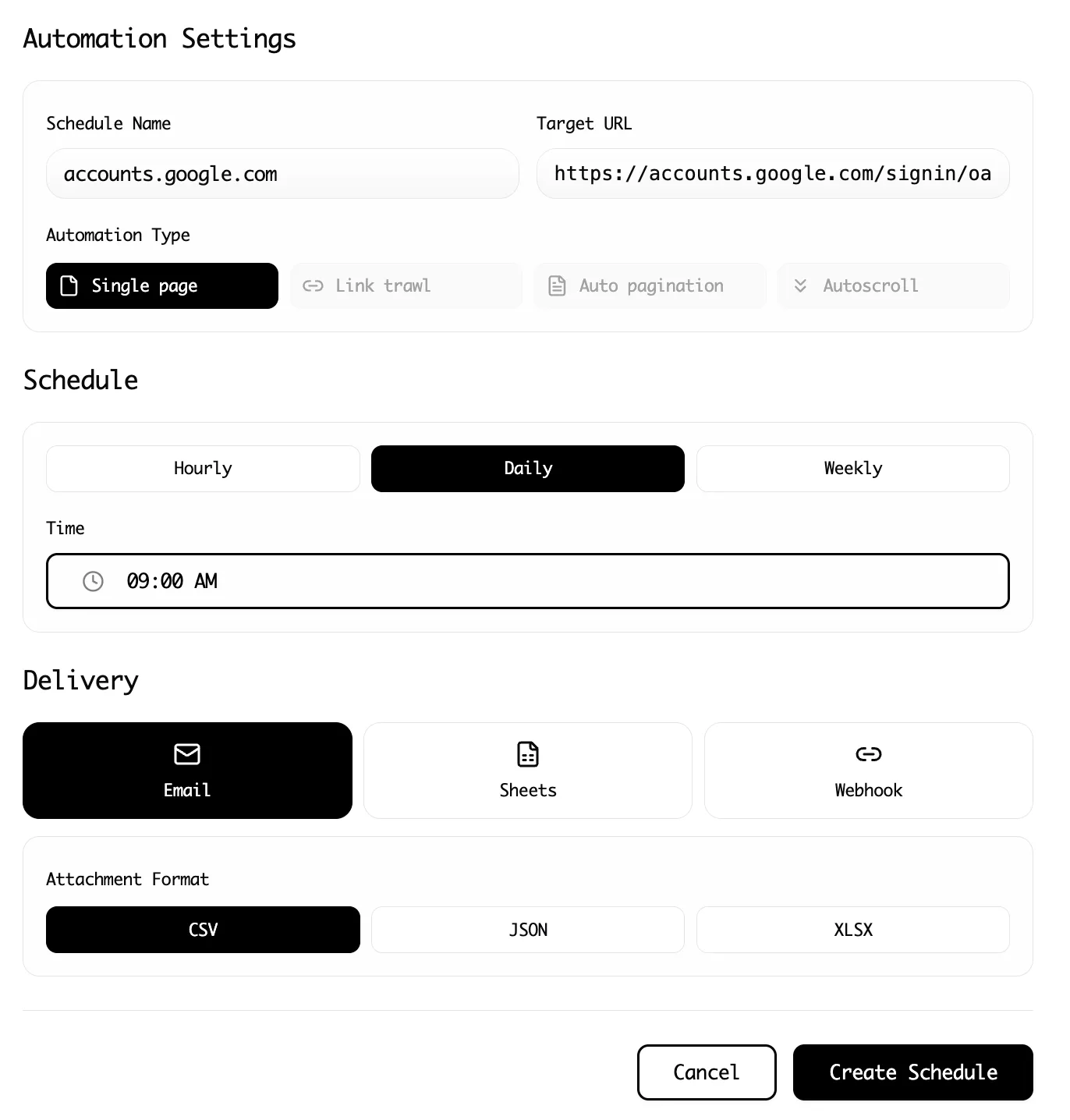
Lection is not a general-purpose SERP API. It does not replace a backend that must answer thousands of application requests per minute or provide a standardized search service to other customers. It is a better fit when the goal is a reusable research process, especially for analysts and operators who need a visible way to maintain it.
How should you compare the alternatives?
Use one real evaluation instead of comparing feature pages in isolation. Choose ten representative keywords, two locations, one device type, and the result depth you actually need. Run the same sample through two or three candidates.
Measure the finished workflow:
- Record the time from an empty account to the first trustworthy export.
- Count the required fields that are populated correctly.
- Test organic, local, shopping, news, and other result types separately if they matter.
- Check location and language behavior against a known search result.
- Calculate the effective cost, including retries, enrichment, and storage.
- Change one keyword or location and measure how easy the workflow is to update.
- Ask whether a second person can understand and rerun the process.
Keep source URLs, query parameters, collection dates, and result positions beside the output. That makes a ranking change explainable. It also helps distinguish a real search change from a request that used a different location, device, personalization state, or result type.
What legal and operational checks still apply?
Choosing a SerpApi alternative does not remove responsibility for how search data is collected or used. Review the provider's terms, the search engine's policies, and the legal basis for any personal or sensitive data in the output. Our guides on web scraping legality by country and robots.txt are useful starting points, but they are not legal advice.
Limit collection to the fields you need. Use respectful rates, retain provenance, and avoid presenting an observed search result as a guarantee of what every user sees. If the dataset feeds SEO recommendations, keep the query, location, timestamp, and device context so another person can reproduce the observation.
Which SerpApi alternative should you choose?
Choose DataForSEO when queued, pay-as-you-go SERP collection and low unit costs are central. Choose Serpstack when you want a focused developer API with a narrow integration surface. Choose Bright Data when high-volume collection and broader web data infrastructure justify a larger vendor. Choose Apify when search discovery needs to lead into a reusable crawler or multi-step automation. Choose Lection when analysts need a visible, no-code workflow that can collect and organize the pages behind a search.
SerpApi itself remains a reasonable choice when its engines, result types, throughput, and monthly plans match the workload. The best alternative is the one that produces trustworthy records with a cost the team can explain and a maintenance process someone besides the original builder can own.
Ready to start scraping? Install Lection and extract your first dataset in minutes.