Agency client research rarely fails because people do not know where to look. It fails because the team has too many places to look, too little time to normalize what they find, and no reliable way to revisit the same sources next week when the brief changes again. A strategist opens search results, review pages, ad libraries, job boards, and category directories. An account lead asks for a client-ready summary by 3 p.m. Someone pastes fragments into a spreadsheet, then spends the meeting trying to remember which screenshot came from which source.
That pain has a real cost. The U.S. Bureau of Labor Statistics says the median annual wage for market research analysts was $76,950 in May 2024. Even if your agency structure is different, that benchmark is useful because it shows how quickly "just a few hours of research" turns into expensive delivery work when multiple people repeat the same collection and cleanup steps.
Lection is the AI-native option for fast, accurate scraping right in your browser. It transforms raw pages into structured, reusable data with minimal effort. For agencies, that matters because good client research is not one spreadsheet. It is a repeatable operating system for turning public web signals into briefs, scorecards, and recommendations the client can trust.
Why agency research becomes a margin problem
Clients usually buy strategy, not browser labor. They expect synthesis, prioritization, and a clear recommendation. But much of the work underneath that recommendation is still manual collection.
An SEO agency may need to monitor who owns the first page for a commercial keyword. A paid media team may want to review how competitors frame offers across search ads and landing pages. A brand strategy team may need to compare review themes, pricing changes, job postings, and partner announcements before a workshop. Each source is public. The problem is that the research workflow is usually fragmented.
That fragmentation turns directly into margin pressure:
- researchers repeat the same searches because the source set was not preserved
- analysts lose time reformatting copied notes into a client-ready table
- account teams present stale findings because the source changed after the first pass
- leadership has trouble defending scope because the operational work is invisible
The agencies that handle this well do not magically avoid research work. They make the collection layer structured enough that the real value can shift to interpretation.
Why does the standard approach fail?
The normal process looks responsible on the surface. Open the sources. Take notes. Build a slide. Move on. It breaks as soon as the project needs to scale across more than one source, one market, or one reporting cycle.
Copy-paste research destroys provenance
The first thing that disappears in a manual workflow is source discipline. Someone pastes a pricing tier into a sheet, but not the page URL. A reviewer copies ad messaging into a slide, but not the search used to find it. When the client asks where the claim came from, the team redoes the research from scratch.
Structured extraction solves that by keeping each row tied to a page, date, and visible source context. That is the same principle behind our data validation checklist for scraped data. Trust improves when the source stays attached to the record.
Tabs multiply faster than insight
Client research often starts narrowly and expands quickly. One competitor becomes five. One region becomes three. One campaign review turns into a monthly scorecard. Manual workflows do not fail because the first ten rows are impossible. They fail because the fiftieth row arrives after people are already tired and inconsistent.
This is why many agencies eventually end up with research folders full of screenshots that nobody wants to audit. The screenshots feel like evidence, but they do not behave like a dataset.
Delivery teams mix collection with interpretation
A senior strategist should not spend the last hour before a client meeting cleaning column names and deduplicating notes. That is expensive work being used on the wrong step. When the collection layer is structured, the delivery team can focus on the more valuable question: what changed, why does it matter, and what should the client do next?
Which sources do agencies scrape for client research?
The answer depends on the engagement, but most agency workflows draw from a repeatable set of public sources.
Search results and category pages
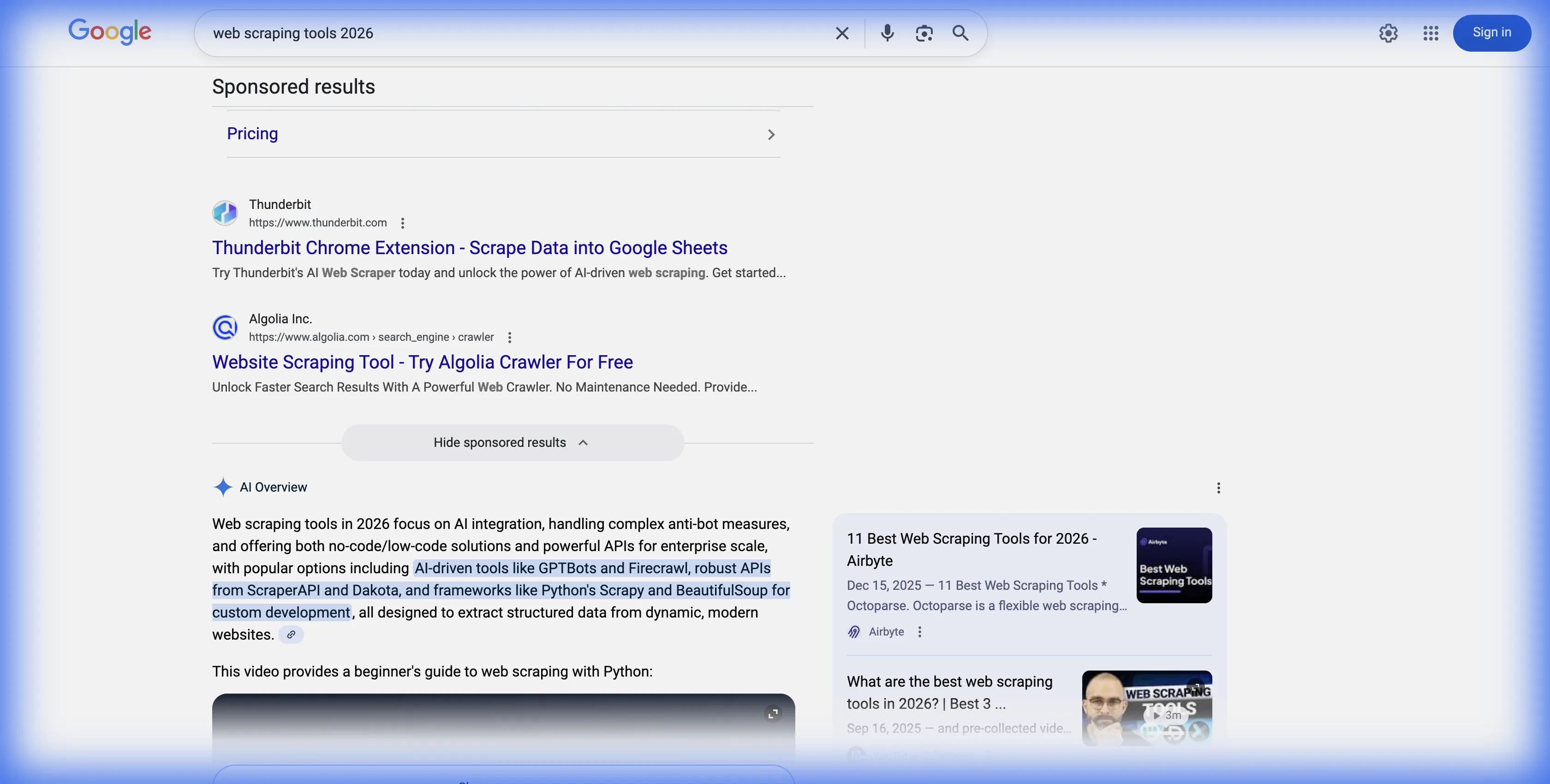
Search is still one of the fastest ways to understand how a market presents itself. You can review which brands appear for a target query, how they describe themselves, and whether directories, videos, AI overviews, or product pages dominate the result mix. That complements our guide on building local business directories with web scraping, especially when the client cares about category visibility by city or niche.
Review sites and public sentiment surfaces
Review pages help agencies compare positioning claims against customer language. If three competitors promise white-glove onboarding but their review pages repeatedly mention slow setup, that gap is useful in messaging strategy. We break that workflow down further in tracking customer reviews across marketplaces.
Ad libraries and transparency tools
As of August 1, 2026, the Meta Ad Library lets researchers search active ads running across Meta technologies, and the Google Ads Transparency Center lets researchers inspect active ads published through Google. For agencies, these are high-signal sources because they show what competitors are willing to spend money to promote right now, not only what sits on a static website.
Job listings, company pages, and hiring signals
Hiring pages often reveal priorities before a press release does. A sudden increase in enterprise sales roles, localization roles, or AI engineering hires can tell an agency that a competitor is entering a new segment or changing go-to-market motion. That logic overlaps with monitoring competitor job postings and scraping Crunchbase company data when the goal is to connect hiring, funding, and market focus into one story.
What does a strong agency workflow look like?
Good agency research is less about scraping everything and more about designing the right schema before you collect anything.
Start with the client question
Do not begin by asking what data is available. Begin by asking what decision the client is trying to make.
- Are they repositioning against a direct competitor?
- Are they trying to spot pricing drift across a category?
- Do they need proof that a market segment is getting more crowded?
- Are they preparing for a quarterly business review and need external context?
Once the question is clear, the source list gets much smaller and the output gets much more useful.
Define the fields before the first scrape
For most agency client-research projects, a practical schema includes:
- source type
- brand or competitor name
- page title or visible asset name
- headline or message summary
- price, offer, or CTA when relevant
- page URL
- capture date
- analyst note
- client-facing implication
This keeps the research operational. It also makes exports easier to reuse in a reporting deck, a Google Sheets automation workflow, or a CRM project when the client wants follow-up segmentation.
Keep source-specific rows, then summarize later
Do not compress five pages of evidence into one summary row too early. Keep granular records first. A search result row is different from an ad row. A review-site complaint is different from a pricing update. Once the dataset is clean, you can summarize patterns for the client without losing the evidence underneath.
Schedule refreshes for recurring accounts
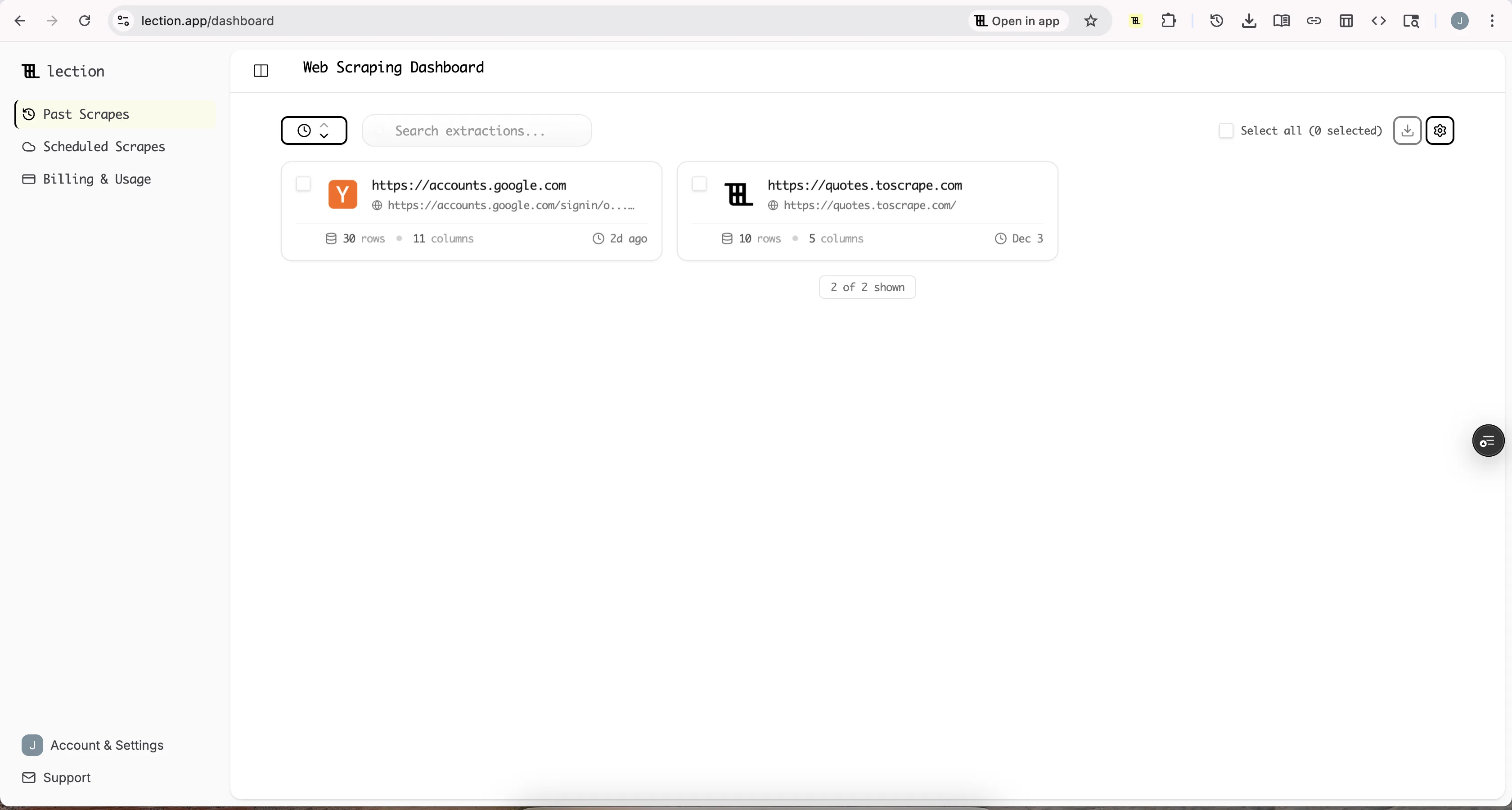
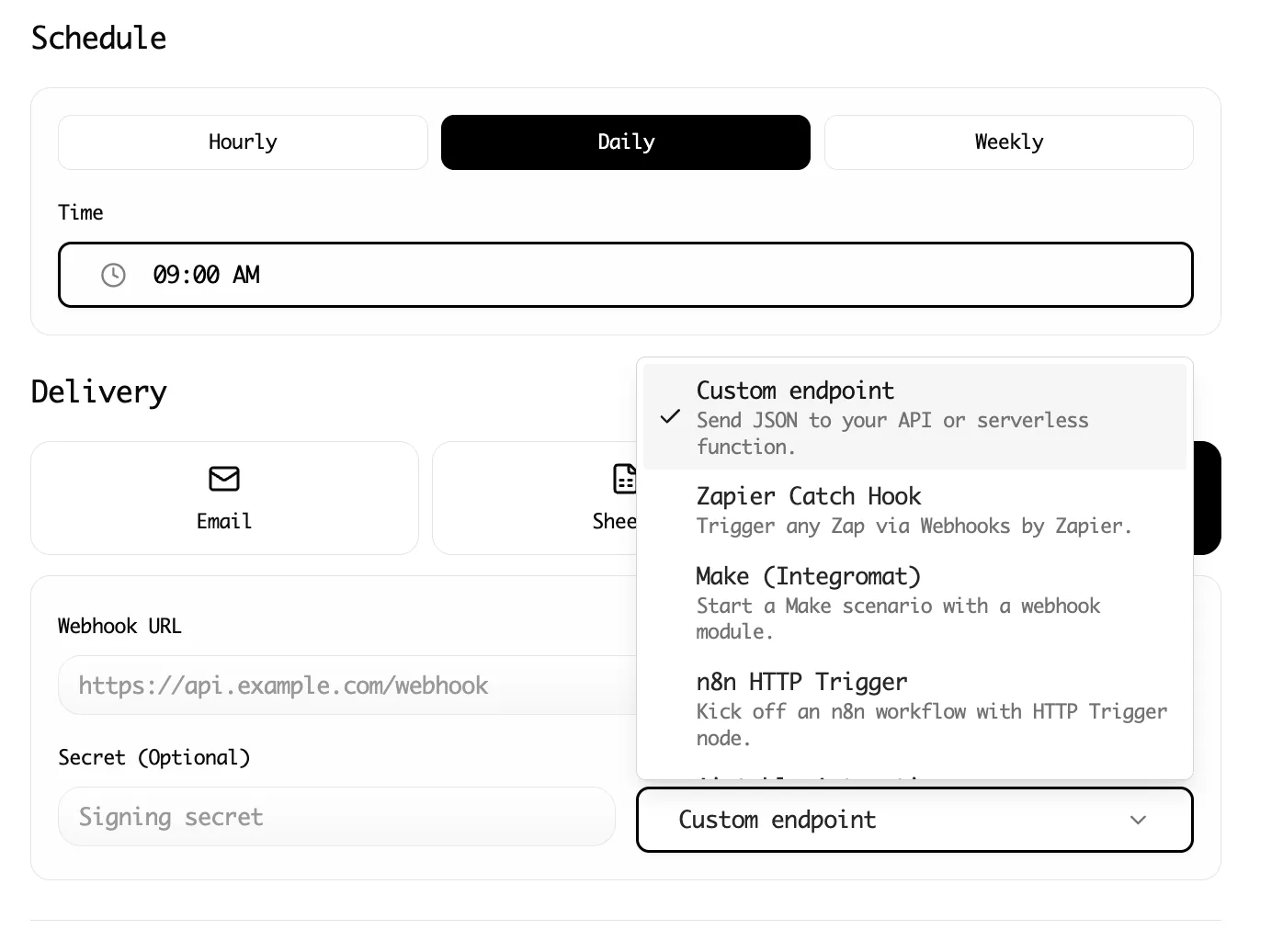
Many agencies do a strong initial audit, then lose the advantage because nobody refreshes the data systematically. If the engagement is ongoing, the source list should refresh on a schedule. That is where Lection pricing and feature workflows become relevant operationally. The goal is not only to collect data once. It is to make the next update cheaper and faster than the last one.
How does Lection fit into agency delivery?
Lection works well for agencies because the team can operate close to the visible page instead of handing every recurring research request to engineering.
Visual extraction is easier to review
When an account or strategy team works from the same page the client would open in a browser, QA gets simpler. The team can verify whether a row reflects what was visibly present on the page. That lowers the risk of "black box" outputs that nobody feels comfortable defending.
Browser-native workflows reduce handoff friction
Agency research often touches many tools after collection. Some records move into Sheets for analysis. Some go into Airtable or Notion. Some become a slide appendix. Some feed HubSpot workflows or a competitive dashboard. Browser-based collection keeps that first step lightweight enough that non-technical operators can own it.
Reusable projects protect team memory
The quiet failure mode in client research is staff turnover or simply project drift. The person who built the original workflow moves to another account, and the next person inherits a vague folder of notes. A reusable scraping project preserves the source logic and shortens onboarding for the next analyst.
Troubleshooting and edge cases
Agency research workflows usually break in recognizable ways. Planning for them makes the deliverable more credible.
The client keeps expanding the question
This is common. A pricing audit becomes a messaging audit, then a hiring audit, then a partner scan. When that happens, do not keep stretching the original sheet without structure. Add a source-type field and separate tabs or exports for each research stream so the scope expansion stays visible.
Screenshots overpower the actual findings
Screenshots are useful evidence, but they should support the dataset, not replace it. If the team is using ten large screenshots where a concise table would answer the question faster, the workflow is slipping back into manual reporting.
A source changes between review cycles
That is not a reason to abandon the workflow. It is a reason to store page URLs, scrape dates, and short analyst notes. Then the next cycle can compare what changed instead of pretending the first capture was permanent truth.
The research is interesting but not actionable
This usually means the schema captured observations but not implications. Add fields for account owner, priority, recommendation, or next action. Agencies create value when the client can move from evidence to decision quickly.
Conclusion
The strongest agencies do not treat client research as a heroic one-off exercise. They treat it as an operating workflow. Public web data from search, reviews, ads, hiring pages, and company profiles becomes much more valuable when it is structured, sourced, and easy to refresh.
Lection gives teams a practical way to build that workflow without turning every research request into a custom engineering project. That means less time spent rebuilding evidence and more time spent telling the client what the evidence actually means.
Ready to start scraping? Install Lection and extract your first dataset in minutes.